Get in Touch with Koven Air Company
Commercial Desiccant Dehumidifier
Commercial Desiccant Dehumidifiers, Rotary Wheel & Liquid Desiccant Systems
Koven Desiccant Line, At a Glance
35 countries served
In-house chiller / heat-pump test lab
24 h aging test
When Refrigerant Dehumidifiers Fall Short, Low Temperature and Low Dew Point
There isn’t one “best” type of dehumidifier, the selection really depend on the dew point and temperature you need to hold. Refrigerant- (compressor) dehumidifiers use cold surfaces to condense and remove moisture. They cool air below its dew point and drain the resulting water. But a compressor can’t go too cold – once the refrigerant coils dip below about 4-7°C (39-45°F) they begin to freeze over, which reduces performance and capacity dramatically, particularly if the incoming air is also cold (below 10°C or 50°F). Trying to use a compressor to reach a very low dew point in a cold environment means ice, short-cycling, or failure to achieve the required dry conditions.
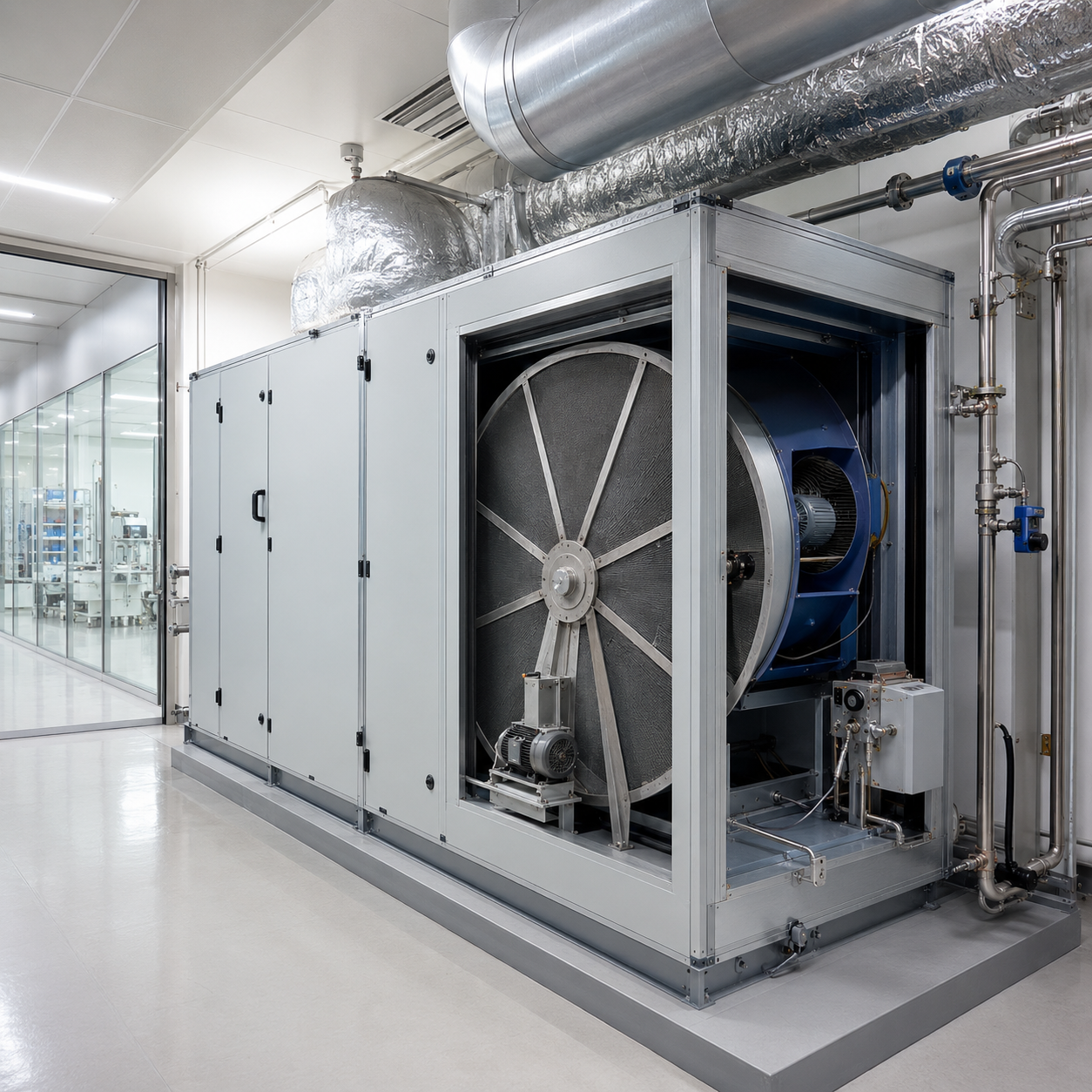
Desiccant dehumidifiers operate on a completely different principle: no cold surface is involved. They expose air to a highly hygroscopic material, like silica gel or a lithium chloride solution, which adsorbs the moisture. Heat then regenerates the material by driving the absorbed water vapor off. Because no freezing can occur, a desiccant system can operate reliably at air temperatures below zero and achieve much lower dew points (down to -40°C) than a compressor could ever approach. This is precisely why ice rinks, cold storage, pharmaceutical dry rooms, and lines manufacturing lithium-based batteries specify desiccant equipment, instead of adding more refrigeration.
Front-line reality (contradiction worth knowing): a facility can meet a 40% RH set-point on paper and still get condensation and corrosion. A U.S. military ammunition-storage study found stock corroding even while the space held its RH spec — because the real target is preventing surface condensation and dew-point excursions, not hitting an RH number. Desiccant control manages the dew point, which is what actually protects the product.
In simple terms: keep refrigerant for when air is warm and low-dew point performance is “good enough.” Move to desiccant for when the air is cold, the dew-point target is extremely low, or a condensation risk, rather than simply comfort, dictates performance requirements. This page explains the latter and details Koven’s commercial and industrial rotary and liquid desiccant dehumidifier line-up. For ASHRAE recommendations regarding the boundaries between these two types, see the ASHRAE Handbook (Refrigeration, Ch. 44 and Fundamentals).
That’s why Koven Air designs and manufactures an entire line of industrial desiccant dehumidifiers for humidity control – we don’t just resell underperforming refrigerant units on the edge of their capability. Every desiccant dehumidifier we produce is built on the same 400-point-traceability line and runs a 24-hour aging test before shipment, and each unit is selection-matched with our software to the dew-point target stated in your proposal — so the specification you approve is the specification the unit is built and quoted to, something a stock refrigerant unit on the edge of its range cannot promise.
Koven KSD-D/Q Rotary Desiccant Dehumidifiers, Models & Selection
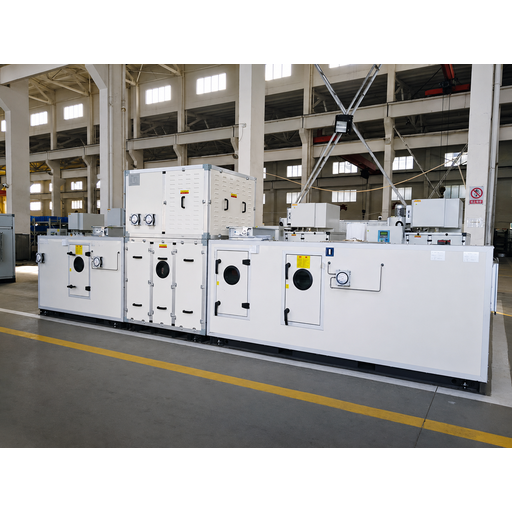
Koven’s rotary series is the KSD-D/Q-B/Z Combined Desiccant Dehumidifier – a package air-handling unit around a standard desiccant rotor, a medium-efficiency inlet filter, a front and rear set of cooling coils, and the process and supply fans – packaged into a single, self-contained box. The product is available in 8 standard sizes across 1,500 to 30,000 m³/h of process airflow (approx. 880 to 17,600 CFM), and each size is re-configurable into a non-standard unit custom-built to the required target for dry air temperature, humidity and cleanliness. Undersize by as little as one size model and you’ll be leaving 20-30% of the dehumidification headroom you’d need on your peak load day – a costly misstep – so the KSD range is purposely granular – a true heavy-duty commercial dehumidifier platform, rather than a standard unit forced to perform at the limits.
The model code provide at a glance configuration: D or Q denotes regeneration heat source (electric or steam, respectively – the former having lower operating costs when a steam supply is available on site). B or Z denotes cooling source (water or direct expansion, respectively – B require 12°C chilled water, Z has self-contained refrigeration). Pair the code letters to your existing site utilities, then size the 2 or 3 digit numerical identifier (10-200) to match your process airflows.
KSD Capacity-to-Application Selection Matrix — Direct-Expansion (-Z) standard units
| Model | Process airflow (m³/h) | ≈ CFM | Cooling capacity (kW) | Filter area (m²) | Total power (kW)* | Outlet residual pressure (Pa) |
|---|---|---|---|---|---|---|
| KSD-10D/Q-Z | 1,500 | ≈880 | 26.5 | 1.8 | 30 / 10.8 | ≥300 |
| KSD-20D/Q-Z | 3,000 | ≈1,765 | 40.5 | 2.9 | 44.9 / 16.2 | ≥300 |
| KSD-30D/Q-Z | 5,000 | ≈2,940 | 63.5 | 4.6 | 73.4 / 25.6 | ≥300 |
| KSD-50D/Q-Z | 8,000 | ≈4,700 | 99.5 | 7.8 | 120.4 / 43.9 | ≥300 |
| KSD-80Q-Z | 12,000 | ≈7,060 | 146.5 | 13 | 68.1 | ≥300 |
| KSD-120Q-Z | 20,000 | ≈11,770 | 244.3 | 22 | 105.3 | ≥300 |
| KSD-150Q-Z | 25,000 | ≈14,710 | 317.5 | 27.5 | 131.3 | ≥300 |
| KSD-200Q-Z | 30,000 | ≈17,650 | 405 | 32.5 | 163.5 | ≥300 |
*For those applications where there’s a water service, the -B chilled-water (surface-cooling) models can also be specified with 7°C supply in place of 12°C for equivalent airflow volumes. Dimensions, coil-layout and connection details for individual sizes can be found on the KSD series datasheet, downloadable from our website. Standard performance operating point for standard size models: 27°C, 60%RH @ inlet and auto-controlled between 18 and 25°C at 15-45%RH. Refrigerant type for DX models configured to suit destination market’s latest regulations – confirmed at time of order.
A word of explanation on dehumidifier datasheets: standard ratings show airflow, with input/output temperatures and relative humidity ranges. What the data *doesn’t* tell you directly is moisture removal capacity on an airflow basis – that’s simply the airflow multiplied by the moisture content drop across the rotor, or the moisture removal capacity / airflow for a given input and output air condition, that our selection software matches against your specific load. DOE/NREL researchers calculate this way, as this is how it must be validated, rather than just copying a nameplate number off the side of a box. Recent improvements in rotor technology, for example USPTO application US 2022/0381452 A1 (a directly-heated desiccant wheel) — aim to cut energy use through better regeneration efficiency, and Koven Air’s rotors sit in that same silica-gel and molecular-sieve family. That patent is third-party industry art, not a Koven filing.
One caveat worth flagging up front: undersize a heavy duty commercial dehumidifier by even one model step and you can lose 20–30% of moisture-removal headroom on the design day — an expensive mistake, because a rotor chosen on airflow alone can fall short. That is the reason Koven Air confirms rotor capacity and temperature rise against the measured load with selection software before quoting, unlike suppliers who quote off a nameplate, and why every KSD unit ships only after 36 factory inspections and a 24-hour aging test.
Rotary Wheel vs Liquid Desiccant vs Refrigerant, How to Choose
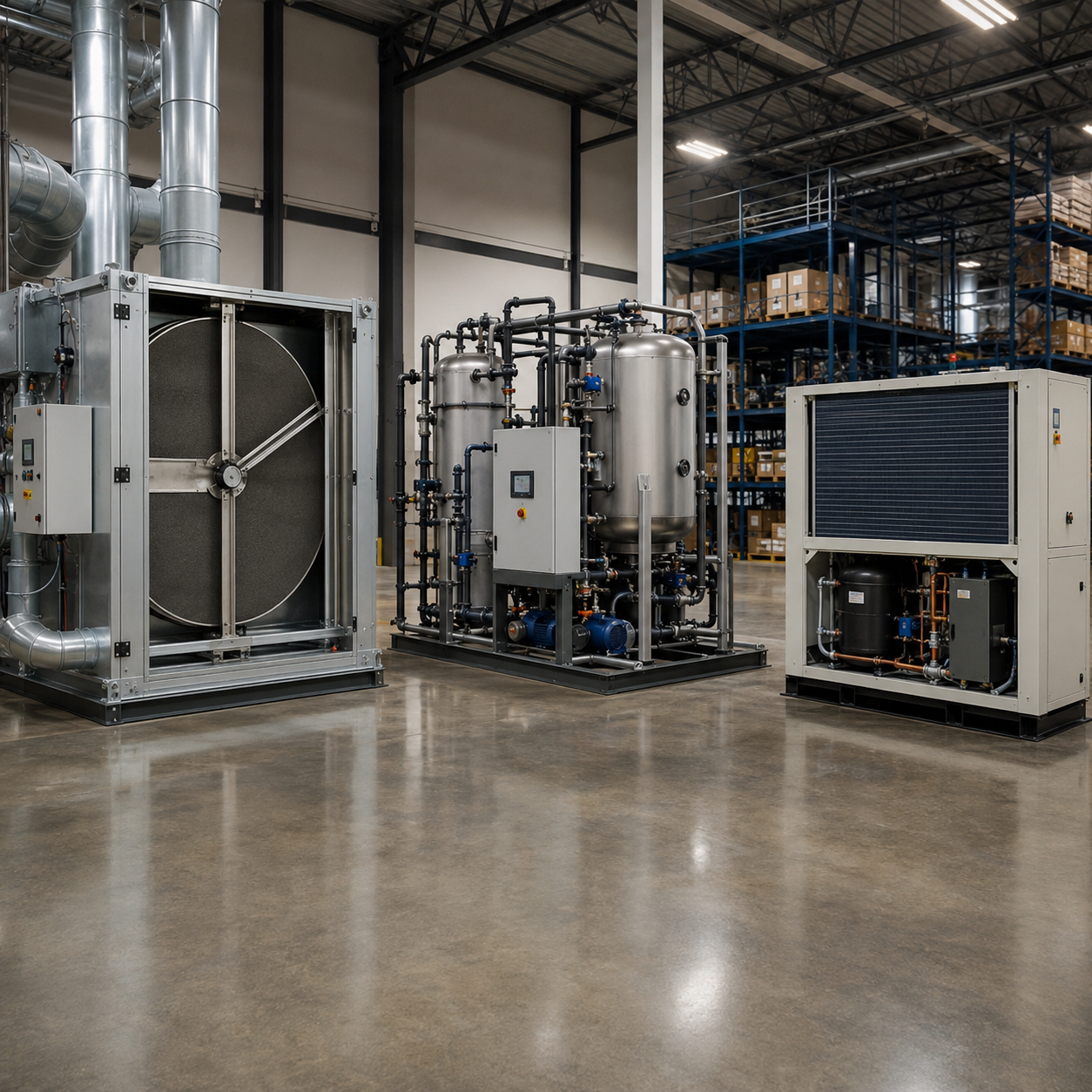
There are three technologies competing for a dehumidification task and it’s an engineering choice with a cost tail rather than a brand choice. Refrigeration is the cheapest to operate in warm air and with a mild dew point. A rotary desiccant wheel commands the cold, low-dew-point air. A liquid desiccant system (lithium chloride or salt solution) gives you deep drying along with air washing, plus the ability to store some drying capacity in the solution. Koven has both types of that table: The KSD line of rotary-wheel dehumidifiers is shown here; Koven’s other product line of liquid desiccant dehumidifiers targets very deep, very low dew points.
Desiccant-vs-Refrigerant Crossover — what each technology actually delivers
| Factor | Refrigerant (compressor) | Rotary desiccant wheel | Liquid desiccant |
|---|---|---|---|
| Practical dew-point floor | +4 to +7 °C (39–45 °F) | to ≈ −40 °C | to ≈ −40 °C, deep low-RH |
| Behaviour in cold air (<10 °C) | Capacity falls; coil frost risk | Unaffected | Unaffected |
| Effect on supply-air temperature | Cools & dries | Adds heat (≈+13 °C across rotor) | Near-isothermal; can cool |
| Energy character | Efficient in warm/mild duty | Regen heat (COP < 0.6) | Regen heat; heat-recovery friendly |
| Best fit | Warm spaces, mild RH, comfort | Ice rinks, cold rooms, process air | Dry rooms, deep low-RH, corrosive/coastal |
The honest trade-off: desiccant is not free
There are two major costs of desiccant dehumidification that a thoughtful specifier anticipates. One is regeneration energy – driving the moisture back out of the wheel cost heat and the thermal COP of a desiccant stage is usually below 0.6. It’s often the largest single operating cost in a desiccant unit. Second is the adsorption heat released during drying, which warms up the process air about 13 °C. That’s a penalty to re-cool in warm space and welcome heat in a cold space. That’s why desiccant works in ice arenas but not a warm swimming pool hall, and why Koven Air engineers the combination units so that the process air coming out of reactivation is warm, but the air supplied to the space comes out of two coils, typically around 18 to 25 °C. That in-house matching make a unit truly a system, not just a coil bolted to a rotor.
There’s also some potential to recover regeneration heat, as in the ice-rink case study at the bottom of this article, which reduced the regeneration and overall energy significantly by using a condensation heat recovery process. If you compare technologies, compare them at the dew point you need to achieve. Below a certain temperature-typically around 40 F-refrigeration isn’t possible, and even if it were possible it would be very expensive, leaving desiccant as the only option.
Ice Rink & Indoor Pool Dehumidification
Cold Storage, Dry Rooms & Low-Temperature Warehouses
The colder and drier the air you’re handling, the more effectively desiccant wins out – and the greater the shift away from standard rotating-dehumidifier units toward specially designed or liquid-dehumidifier units. Low temperature cold storage, freezers anterooms and warehouses face coil-and-product frosting every time any ambient humidity creeps below the freezing point – with pre-drying of both the air being used and the ambient infiltration air with a desiccant system stopping the problem at its origin through adsorption, whereas a refrigerative system would simply produce a more resistant ice layer. Koven Air’s custom non-standard KSD line of desiccant dehumidifiers are built to the required dry air temperature and humidity along the same 400 point traceability line as their standard units, inspected and aging-tested to the same factory QA standard, then shipped – in contrast to the catalog description of an ordinary dehumidifier.
The extreme end – lithium-battery dry rooms and pharmaceutical dry rooms – need dew points down to −30 °C to −60 °C, below 1% RH, something a refrigeration system could never achieve because the coils would freeze over solid long before the air ever got that dry. This is deep low-RH work; it’s a job for Koven Air’s liquid desiccant or lithium-battery dry-room lines, designed for sub-zero dew points, and not the combined-rotor standard unit rated at 15 – 45% outlet RH. If you need low RH in a cool room, that’s a job for the standard KSD line; if you need a sub-zero dew point, that’s a job for the deep-drying line. This is the honest split rather than a single datasheet trying to straddle the two requirements.
Warehouses and general storage fall in between. The most common need is to keep moisture below the mold and corrosion threshold, rather than to achieve a specific process-grade dew point. Here, sizing discipline becomes more important than sheer capacity, which is what we cover next. ASHRAE guidelines on moisture control — referenced in the U.S. DOE Building Energy Codes materials — suggest that a more useful goal than meeting a specific RH value is to “prevent condensation.”
Certifications & Manufacturing Quality
Buying an environmental-control unit from an overseas manufacturer come down to one question procurement actually asks: can this factory build it right and stand behind it? The real risk on a project clock is a unit that fail inspection or arrives mis-certified – an expensive delay. Koven Air answers that with process control you can audit, not adjectives, because 36 documented factory inspections beat a marketing sentence every time. Every unit runs through 18 standardized production processes and 23 sheet-metal precision machining stations with intelligent robotic modular assembly, 400 process traceability points, 36 factory inspections, and a 24-hour aging test before shipment – and chillers and heat pumps are proof-tested in an in-house testing lab rather than only on paper. That’s the manufacturing evidence behind a 35-country installed base since 2010.
On third-party certifications, and unlike suppliers who paste badges they cannot back, Koven Air states only what applies: desiccant dehumidification performance is characterized by test methods such as ANSI/ASHRAE 139 (method of test for rating desiccant dehumidifiers) and AHRI 940 for desiccant equipment; the refrigerant/pool contrast is covered by AHRI 910/920 and ASHRAE 174. Which product certifications and listings ship with a given unit depend on the destination market and the configuration, and are confirmed in writing at order – Koven does not claim a listing a unit does not carry. Buyers can and should verify any certified-performance claim through the AHRI Certification Directory and the standard scope on ashrae.org.
Procurement, Customization, Lead Time, US Support & Lifetime After-Sales
Delivered cost and support risk decide more desiccant tenders than sticker price, so it helps to see what actually drives a Koven quotation. Rather than a list price, price is set by a handful of configuration factors, and knowing them lets you value-engineer before you buy:
Airflow & capacity – the KSD size (10-200) that matches your process airflow and moisture load.
Cooling source – chilled-water (-B) if you already have a 12 C loop, or self-contained DX (-Z) if you don’t; DX raises unit cost but removes a plant dependency.
Regeneration source – steam (Q) trims running cost where steam exists; electric (D) simplifies installation.
Catalog size vs a non-standard build to a specified dry-air temperature, humidity and cleanliness.
Control accuracy, filter grade, and the refrigerant and listing set required for your destination market.
What desiccant actually costs to run, and where it pays back
Support & Lifetime After-Sales
As one year-round rink operator put it, “when we decided to go year round we had to have a proper desiccant unit installed to maintain proper humidity and air quality” — and unlike a discount box with no engineering behind it, that lifetime after-sales relationship is as much the product as the crate.


![Commercial Rooftop Unit Guide: Types, Sizing & Costs [2026]](https://kovenair.com/wp-content/uploads/2026/07/commercial-rooftop-unit-guide-featured-2-150x150.png)