Air Handling Units

Commercial & Industrial Air Handling Units, Custom Modular AHU Manufacturer

Koven Air designs and builds custom modular air handling units sized to your actual load, not rounded up to the nearest catalog box. One platform spans 1,500–350,000 m³/h airflow and G4 to HEPA H14 filtration, delivered to projects in 35+ countries since 2007.

1,500–350,000

Airflow, m³/h

8.5–5,500

Cooling, kW

G4–H14

Filtration class

±0.5°C / ±2%

Temp / humidity

L1

EN 1886 casing target

20,000+

Project references
Commercial Air Handling Units
Industrial Modular AHU
Custom AHU Manufacturer

Struggling to Source an AHU That Fits Your Exact Load, Filtration & Footprint?

Most specification pain starts with a mismatch: the catalog unit is close, but not right for your coil rows, filter stage or plant-room footprint. So engineers round up, and that’s where the trouble begins.

Quick answer

An air handling unit (AHU) is a modular device that filters, heats, cools, humidifies and circulates conditioned air through a building’s ductwork. A commercial or industrial AHU is built to order for a specific airflow, external static pressure and filtration class, it isn’t the same as a residential “air handler” or a packaged rooftop unit.

That trade-off is real. In a semiconductor fab, Koven engineers sized a make-up air unit to hold 45% RH at 24/7 duty, because an oversized unit would swing humidity and cost more to run than the customer paid for it. That’s why Koven sizes from the load curve, not the catalog.

Koven Air solves this at the source. Every unit is configured from 1,000+ modular options and controlled to ±0.5°C / ±2% RH in precision builds.

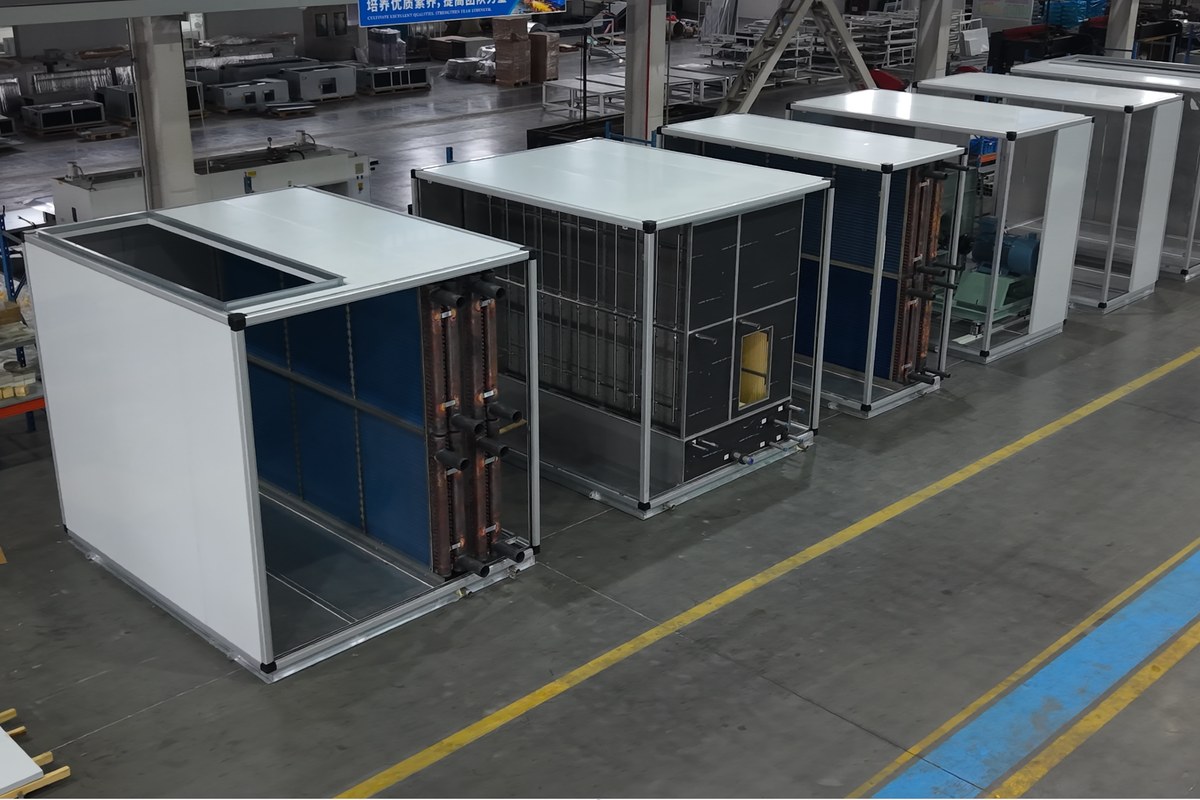
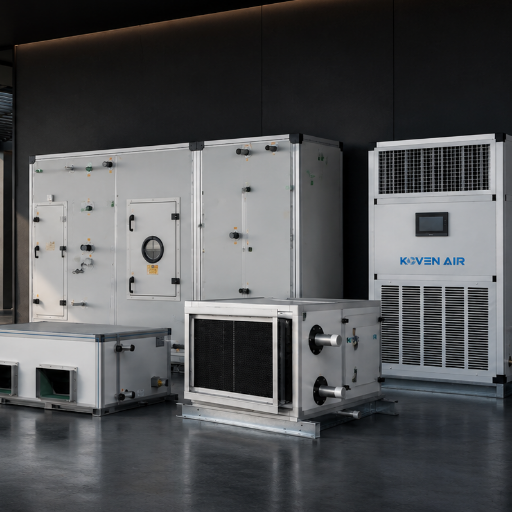
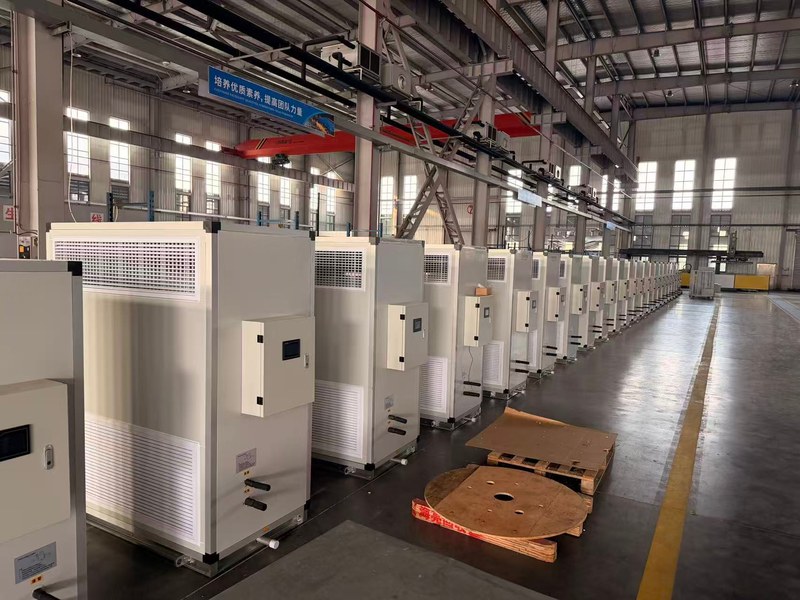
Koven modular commercial air handling unit assembly in factory

Field reality, not always bigger is better

Oversizing an AHU is a common assumption that backfires, and an expensive mistake. A unit specified 30% over the real load short-cycles because the coil never reaches steady state, so it wears faster and holds humidity poorly. Unlike padding the spec sheet, matching the unit to the actual load is what protects efficiency.

Pain

Catalog AHUs force a compromise on airflow, filtration or footprint.

Cause

Fixed product ranges can’t hit every load point, so buyers over-specify.

Solution

Sectional modular platform sized to the actual duty.

Proof

Across 100+ units at Tesla Gigafactory, delivered temperature accuracy held to ±1°C.

The Koven Air AHU Range, Six Configurations on One Modular Platform

One platform, six duty-specific builds. Each configuration shares the same casing, EC direct-drive fans and PLC control core, so you get consistent build quality with duty-matched internals.

Inside the Platform, How Each Section Conditions Your Air

Air moves through a defined sequence, and every Koven section is selected for your duty. This is what makes the platform modular rather than a fixed box.
Step 01
A mixing box with motorized dampers blends fresh air intake and return air, setting indoor air quality from the first stage.
01
Step 02
The cooling coil, chilled water, or a DX evaporator charged with refrigerant, drops air temperature and humidity levels; DX builds pair with a matching outdoor unit.
02
Step 03
The heating coil handles heating or cooling changeover from hot water, electric heat, steam or a boiler feed.
03
Step 04
An EC blower moves the air so the unit can circulate air and distribute conditioned air throughout the building through supply and return duct.
04
Step 05
The control system runs on an integrated PLC with thermostat inputs and variable air volume control, holding energy efficiency as demand-based air flow rises and falls.
05
Demand control like this is what a fixed-speed air conditioner or furnace in a commercial building can’t match. It’s HVAC equipment built for heating and cooling at scale, keeping indoor air, air conditioning and humidity levels on target while it maintains indoor air quality across large air volumes, and the control systems log every setpoint.
Make-up Air Unit (MAU)

Make-up Air Unit (MAU)

100% fresh air · up to 350,000 m³/h · 5,500 kW · 500 kW fan
Full outdoor-air processing for industrial process spaces. Adds R134A option.
View Make-up Air Unit
Cleanroom AHU (Pharma / Biotech)

Cleanroom AHU (Pharma / Biotech)

HEPA H13–H14 · up to 240,000 m³/h · ESP to 2,000 Pa
Highest filtration in the range, built for ISO 14644 cleanroom classes.
View Cleanroom AHU
Hospital AHU (HTM-03-01 duty)

Hospital AHU (HTM-03-01 duty)

Filtration H11–H13 · positive/negative room pressure
Operating-theatre grade with pressure-cascade control (DIN 1946 hygiene).
View Hospital AHU
Heat Recovery AHU

Heat Recovery AHU

Plate heat exchanger · DX or CHW · 3,000–100,000 m³/h
Reclaims exhaust-air energy where the fresh-air load is high.
View Heat Recovery AHU
Commercial AHU (HVAC)

Commercial AHU (HVAC)

Up to 200,000 m³/h · VFD auto-adjust to CO₂ / occupancy
For malls, offices and public buildings; LEED / WELL project support.
View Commercial AHU
Ceiling-Mounted Air Handler

Ceiling-Mounted Air Handler

Low static 80–400 Pa · CHW / HW · jet throw to 30 m
Compact plant-free installs; ties to the vertical ZKL jet series.
View Ceiling-Mounted
Parameter Commercial Cleanroom Ceiling Make-up Air Hospital Heat Recovery
Cooling, kW 8.5–560 8.5–2000 11.6–190 30–5,500 8.5–2000 25–850
Airflow, m³/h 1,500–44,000 1,500–240,000 1,000–15,000 3,000–350,000 1,500–240,000 3,000–100,000
ESP, Pa 200–1800 200–2000 80–400 200–2000 200–2000 200–2000
Fan power, kW 0.8–22 0.8–220 0.18–5.5 0.8–500 0.8–220 0.8–90
Filter class G4/M5–M6/F7–F9 up to H13–H14 G4 (+F7–F8) G4/F7–F9/H11–H14 G4/F7–F9/H11–H13 G4/F7–F9/H11–H13
Air inlet Fresh / Return Fresh / Return Fresh / Return Fresh only Fresh / Return Fresh / Return
Source: Koven Air AHU catalogue & specification workbook. Real model series: KAZKW007–360 (DX modular), KAW03–50-JT (chilled water, 4/6/8-row coils), ZKL020–200 (vertical, jet nozzles φ315–φ500).
Application Best-fit configuration Key driver
Pharma / biotech cleanroom Cleanroom AHU HEPA H13–H14
Operating theatre / hospital Hospital AHU Pressure cascade + H11–H13
Full-fresh-air process (electronics) Make-up Air Unit 350,000 m³/h, 100% OA
Mall / office / public building Commercial AHU VFD demand control
High fresh-air load, energy targets Heat Recovery AHU Plate exchanger reclaim
Low plant-room height Ceiling-Mounted 80–400 Pa, jet throw 30 m

Engineering note, controls & integration

Every unit runs an integrated PLC with VFD and EC fan speed control, sensing temperature, humidity, CO₂, HCHO and PM2.5. It talks to your building management system over BACnet MS/TP and Modbus RTU/TCP, so integration is a configuration step, not a custom project. Cleanroom classification standards are defined in ISO 14644-1; filtration equivalence follows ISO 16890.
Need a fresh air handling unit sized to a specific ISO 14644 class?
Get a Custom AHU Sizing with your airflow, ESP and filter class →

Commercial AHU vs. Residential Air Handler vs. Packaged Rooftop Unit

Buyers often shop three different products under one search term. The specification gap between them is large, and it decides whether your building hits its filtration, pressure and energy targets.

Specification Koven Modular AHU Residential Air Handler Packaged RTU
External static pressure 200–2,000 Pa ~50–250 Pa 250–750 Pa
Filtration ceiling HEPA H14 MERV 8–13 MERV 8–14
Airflow ceiling 350,000 m³/h ~3,400 m³/h ~85,000 m³/h
Casing air leakage EN 1886 Class L1 target Not classified Varies
Configurability 1,000+ modular builds Fixed sizes Fixed sizes
Humidity control ±2% (precision) None / basic Basic
Visual Comparison
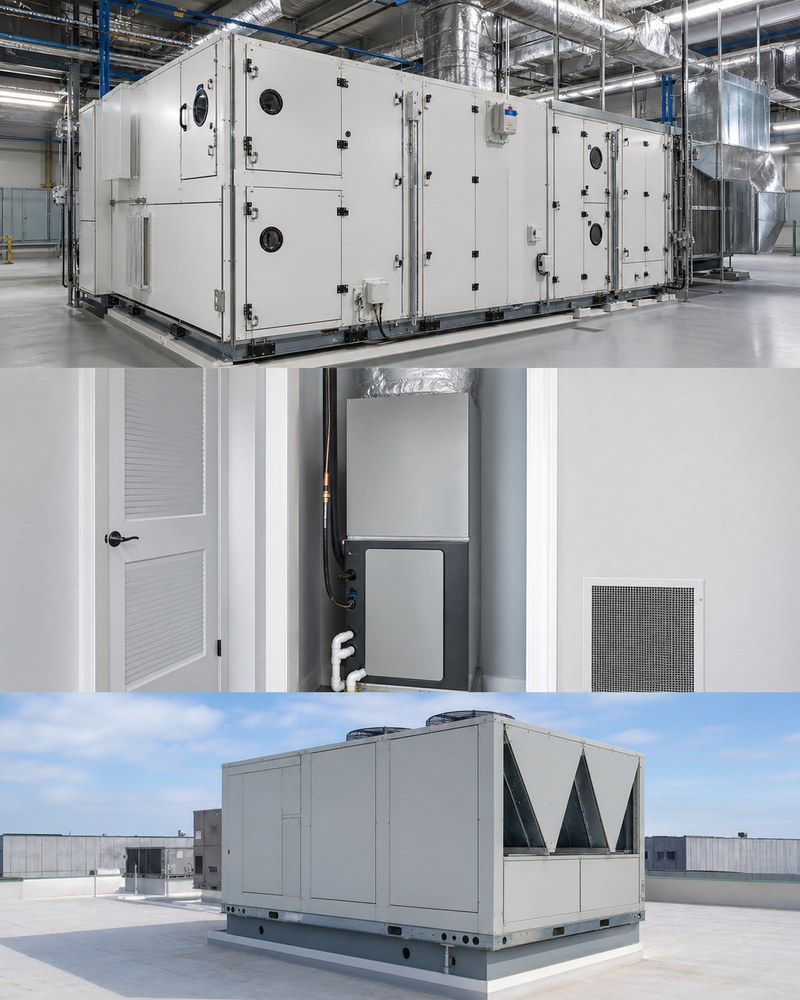
Visual comparison of modular commercial AHU, residential air handler and packaged rooftop unit
Design Footprint Structural footprint difference: Industrial duty vs. Light commercial

Pain

a residential air handler can’t hold cleanroom pressure or HEPA filtration.

Cause

shared terminology hides a 10× difference in static pressure capability.

Solution

a duty-built modular AHU matched to your class and load.

Proof

casings engineered to documented AHU construction methods reach EN 1886 Class L1 sealing performance.

Unlike a residential air handler that tops out near 250 Pa, a modular AHU holds 2,000 Pa, the trade-off buyers miss when they weigh an air handlers hvac catalog price against a duty-built unit. Rooftop air handling units and packaged ahu unit builds fix you to one size; in a data center retrofit, that difference decided whether filtration reached HEPA at the required air flow.

Proven in the Field, Gigafactory, Hospital ORs & Electronics Fabs

A supplier’s premium badge isn’t the same as delivered reliability. The mistake buyers make is trusting the logo, because field reports show even premium units arrive with QC problems, unlike the measured record below. Among commercial air handling unit manufacturers, few publish on-page numbers this specific.

Koven hospital AHU installation for operating room ventilation project
SYS.DATA.FEED // ACTIVE

1.8–4 yr

Typical AHU energy-upgrade payback range (external industry benchmark)

External benchmark — independent AHU ROI study, i-Flow Technologies. Koven cases show VFD savings up to 40% and steam plate-exchanger savings of ~50% vs. traditional heating.

Named threshold, The 400 Pa Leakage Line

The 400 Pa Leakage Line is where a casing either holds its designed pressure or bleeds conditioned air: Koven casings are tested to 0.1% air leakage at ±400 Pa test pressure. On the Tesla build this reached EN 1886 Class L1. Air-to-air energy recovery design follows the recovery-wheel and plate-exchanger art and ASHRAE energy-recovery guidance.

Tesla Shanghai Gigafactory, 100+ AHUs

  • Casing air leakage reached Class L1; structure to TB1 no-thermal-bridge.
  • Roughly 20% more energy-saving than ordinary AHUs, with temperature accuracy of ±1°C across the 860,000 m² site.
  • Whole-factory airflow validated by CFD simulation before build.

Indonesia Hospital Operating Rooms

  • Coastal, corrosive, >80% ambient humidity; 200 m from the sea.
  • Held OR conditions at 19–24°C, 50–60% RH with HCHO / PM2.5 / CO₂ auto-control and positive/negative pressure cascade.

Ningbo Electronics Factory, Make-up Air Unit

  • 24/7 full fresh air; municipal steam via in-unit plate exchanger cut heating energy by ~50%; humidity held at 45%.
  • Shipped as modular sections for site assembly, no crane-in of a single large box.

Certifications, Casing Quality & the 72-Hour Burn-In Standard

Premium brands aren’t immune to out-of-box quality problems, field reports show that reliability has to be earned per unit, not assumed from a logo. Koven’s answer is a documented factory-acceptance protocol.

Units are engineered to comply with ASHRAE and EN practice and to support LEED / WELL project certification; cleanroom builds are designed for ISO 14644 classes. Casing sealing follows the Eurovent AHU quality criteria framework.

ISO 9001:2015 Quality management
ISO 14001:2015 Environmental
ISO 45001:2018 Occupational H&S
CE EU conformity
DIN 1946 Hygiene directive

The 72-Hour Burn-In Standard, four mandatory factory checks, per unit

Koven AHU casing appearance inspection before factory acceptance
01
Appearance

No visible defects; scratch depth <0.2 mm; weld seams flat and porosity-free.

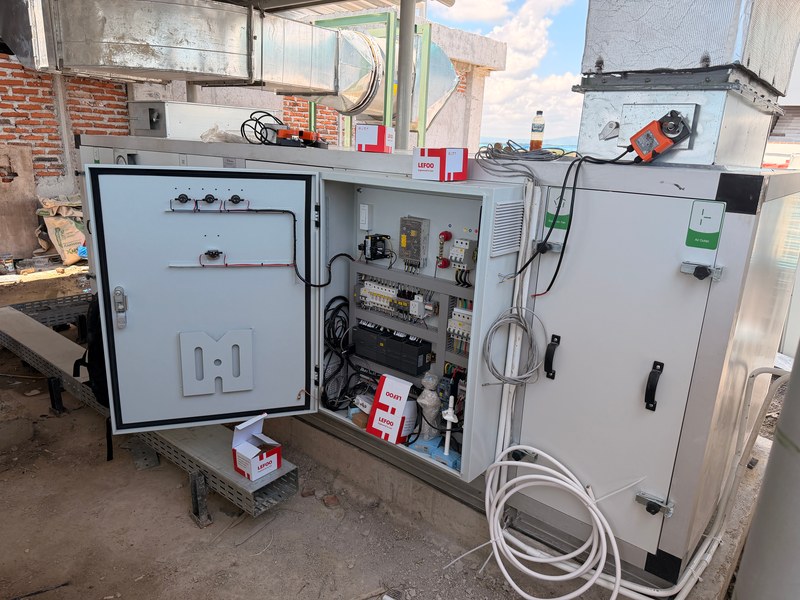
Koven AHU control cabinet wiring and sensor logic test
02
Control logic

Every protection trigger correct; sensor accuracy verified to ±1%.

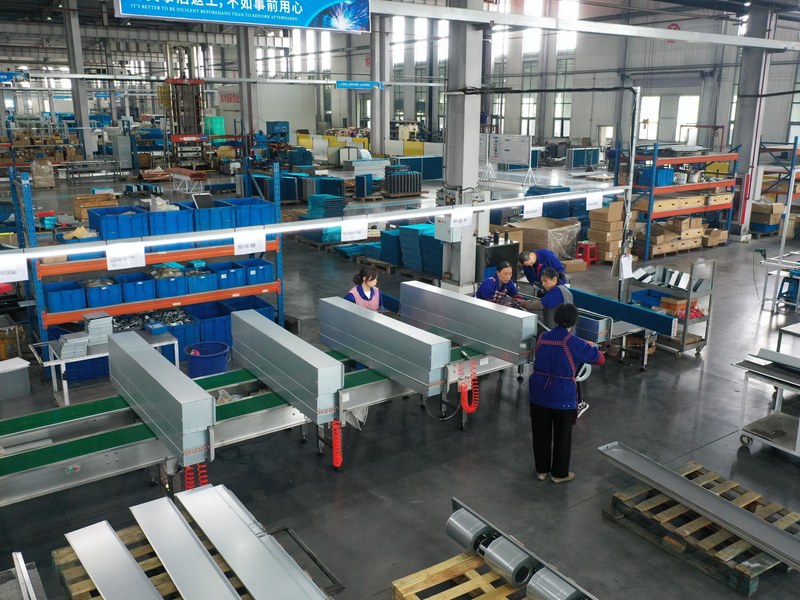
Koven AHU factory performance testing and assembly line
03
Performance

COP/EER ≥95% of design; noise ≤ rated + 3 dB(A), on an enthalpy-difference bench.

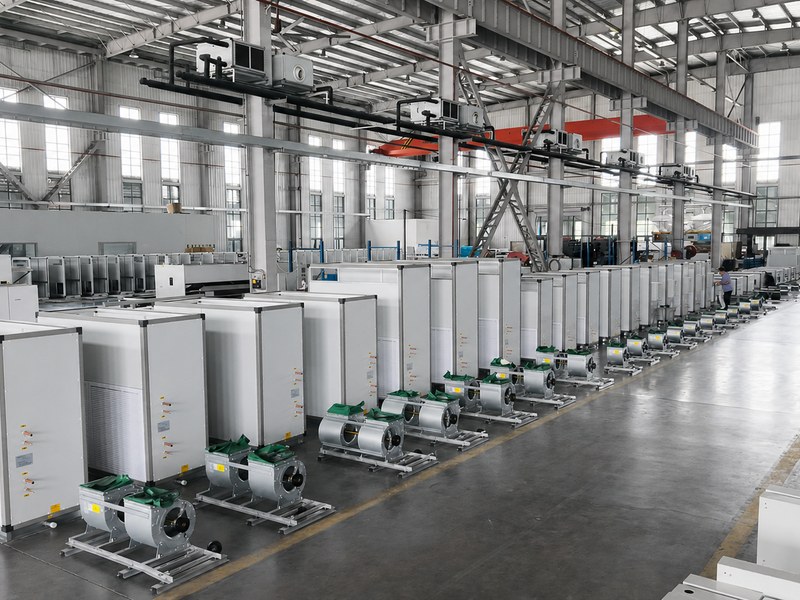
Koven AHU units on 72-hour factory aging burn-in line
04
Aging burn-in

≥72 h continuous fault-free run; parameter fluctuation <±3%; start-stop cycling.

Procurement Guide, Pricing Factors, Lead Time, Customization & After-Sales

By far, the biggest hidden cost in an AHU isn’t the landed price, it’s the electricity it burns for the next 15 years. Buying on landed price alone is the expensive mistake, because operating energy on a 50,000 m³/h unit often costs more than the unit itself over its life. Unlike an opaque quote, Koven opens the pricing factors first, the way industrial air handling unit manufacturers should.

01 What actually drives AHU price
02 Total cost of ownership, where the savings sit
03 Lead time, logistics & After-sales
Request a detailed quotation

What actually drives AHU price

  • Airflow & coil rows — larger duty and more coil rows raise cost.
  • Filtration class — HEPA H13–H14 costs more than F7–F9.
  • Casing & material — C4–C5 anti-corrosion and stainless add cost.
  • Controls & heat recovery — PLC, VFD and plate exchangers add capability and cost.
As a public market anchor, commercial AHUs price at roughly $1.50–2.50 per CFM for modular units and $2.50–5.00 per CFM for custom builds; installed systems range from about $25K to $500K depending on capacity. Koven quotes directly from the factory, removing the distributor margin.

Total cost of ownership

  • VFD demand control cut energy up to 40% vs. fixed-speed on Koven commercial builds.
  • Steam plate-exchanger recovery cut heating energy ~50% on the Ningbo MAU.
  • Independent AHU energy upgrades typically pay back in 1.8–4 years.
  • Lifecycle-cost method follows ISO 50001 energy management principles.

Logistics & After-sales

Lead time & logistics: modular sections ship flat and assemble on site, the route Koven used for the Ningbo fab, and export to 35+ countries.
After-sales: pre-sale parameter verification, on-site commissioning during install, and lifetime technical support with contractor training.

Professional AHU Engineering Suite

01

AHU Unit Converter

Convert airflow, cooling capacity and external static pressure between metric and imperial — the numbers you need to compare an air handling unit spec sheet.

Launch Converter
02

AHU Configuration Finder

Answer three questions and see which of Koven Air’s six air handling unit configurations fits your project.

Find Configuration
03

AHU Energy-Savings Estimator

Estimate the annual energy a fixed-speed air handler wastes against EC-fan, VFD demand control. Koven commercial builds have cut fan energy up to 40% versus fixed-speed.

Calculate Savings

FAQ, Air Handling Units

Find answers to the most common questions about our commercial and industrial air handling solutions.

A commercial air handling unit is a built-to-order modular device that filters, conditions and moves large air volumes through a building’s ductwork, typically 1,500 m³/h and up, at external static pressures a residential air handler can’t reach.
An industrial air handler processes high airflow or 100% fresh air for process environments, electronics fabs, cleanrooms and factories. Koven’s make-up air configuration handles up to 350,000 m³/h of fresh air.
Market pricing runs about $1.50–2.50 per CFM for modular units and $2.50–5.00 per CFM for custom builds; installed systems range from roughly $25K to $500K by capacity. Final price depends on airflow, filtration class, casing material and controls, request a quotation for your parameters.
The two basic types are draw-through and blow-through, and by air source, recirculating (mixed-air) versus make-up (100% fresh air). Koven builds both across all six configurations.
An AHU is a larger central unit that filters and conditions outside and return air for a whole zone; a fan coil unit (FCU) is a smaller terminal unit that conditions recirculated air in a single room. AHUs handle far higher airflow, static pressure and filtration.
An RTU is a packaged, self-contained unit installed on the roof with a fixed size; a modular AHU is configured to your exact duty and can reach far higher static pressure and HEPA filtration.
A make-up air unit supplies 100% fresh (outdoor) air to replace air exhausted from a space; a general AHU usually recirculates a mix of return and outside air. Koven’s MAU is a fresh-air-only configuration of the same platform.